Why Does He Keep Texting but Never Make Plans? 6 Signs to Watch
By George Mangos, Founder of Perscivo · Published
Someone who keeps texting but never makes plans may be hesitant, enjoying the attention, keeping their options open, or misrepresenting themselves. You cannot determine their intentions from messaging frequency alone. Look instead at repeated meeting avoidance, inconsistent explanations, unwillingness to clarify important questions, and whether their actions support the interest they express.
The same applies when she keeps texting but won't meet, or when a dating app match maintains an engaging conversation without progressing toward an actual meeting.
Sometimes the problem isn't a lack of romantic interest. It's that you don't have enough reliable information to know whom you're communicating with.
Why does someone text every day but avoid meeting in person?
You're talking regularly. They're friendly, responsive, and interested in what you're doing.
But whenever you suggest meeting, the conversation changes.
Perhaps they're busy. Perhaps something unexpected happened. Perhaps they say they'd love to meet but never offer an actual date.
One postponed meeting isn't particularly informative. A repeated pattern of avoiding reasonable opportunities to meet deserves a closer look.
The important distinction is between what someone communicates and what their behavior demonstrates.
- You: "Would you like to get coffee Saturday afternoon?"
- Response A: "I'd love to, but Saturday doesn't work. Would Sunday around 2 be good?"
- Response B: "Aww, you're so sweet! How was your day?"
Response A provides a concrete alternative. Response B is friendly but doesn't address the invitation.
One instance of Response B proves little. Repeated instances establish a behavioral pattern worth examining.
Illustrative fictional messages, not a live Perscivo analysis.
Six signs worth watching when a dating app match won't meet
1. They repeatedly avoid direct invitations
You suggest meeting. They acknowledge your message but never answer the actual question.
You suggest another time. Again, the conversation moves elsewhere.
The issue isn't whether they say something pleasant. It's whether meaningful questions receive meaningful answers.
2. They never suggest an alternative date
Being unavailable is normal.
But if someone repeatedly says they're too busy without ever offering another opportunity, you're left with expressions of interest rather than observable progress.
Consider whether the conversation has developed over time or simply become longer.
3. They won't video chat either
An occasional reluctance to video call can have ordinary explanations, including privacy, anxiety, or personal preference.
But repeated refusal to meet or participate in a reasonable real-time conversation, particularly alongside other inconsistencies, warrants caution.
The Federal Trade Commission identifies recurring excuses for not meeting in person as a warning pattern in romance scams, and explains in its consumer alert "Why can't your new love interest meet in person?" why these excuses deserve attention.
A video call is not proof of identity. It is one potential source of additional information.
4. They immediately want to move to WhatsApp or Telegram
Moving conversations away from a dating platform isn't inherently suspicious.
The circumstances matter.
Is there pressure to switch almost immediately? Are they unwilling to continue communicating through the original platform? Do new requests or explanations appear after moving?
The Federal Trade Commission identifies attempts to move conversations off dating platforms as a pattern associated with romance scams.
5. Their explanations become inconsistent
Their location changes. Their occupation or availability seems different from what they previously described. Important details no longer align.
Rather than trying to establish someone's intentions from one discrepancy, examine the accumulated evidence.
What was originally stated? What changed? Was the inconsistency reasonably explained?
6. You know remarkably little despite weeks of messaging
Long conversations can create a sense of familiarity.
But how much have you actually established?
Do you have consistent information? Have important questions been answered? Is the interaction progressing?
Frequent communication and reliable information aren't the same thing.
What does a questionable conversation look like when analyzed?
Here's an example of the kind of information Perscivo provides.
Our fictional Alex/Jordan conversation includes positive signs of engagement alongside unresolved questions about progressing toward a meeting.
Sample Decision Brief (fictional conversation)
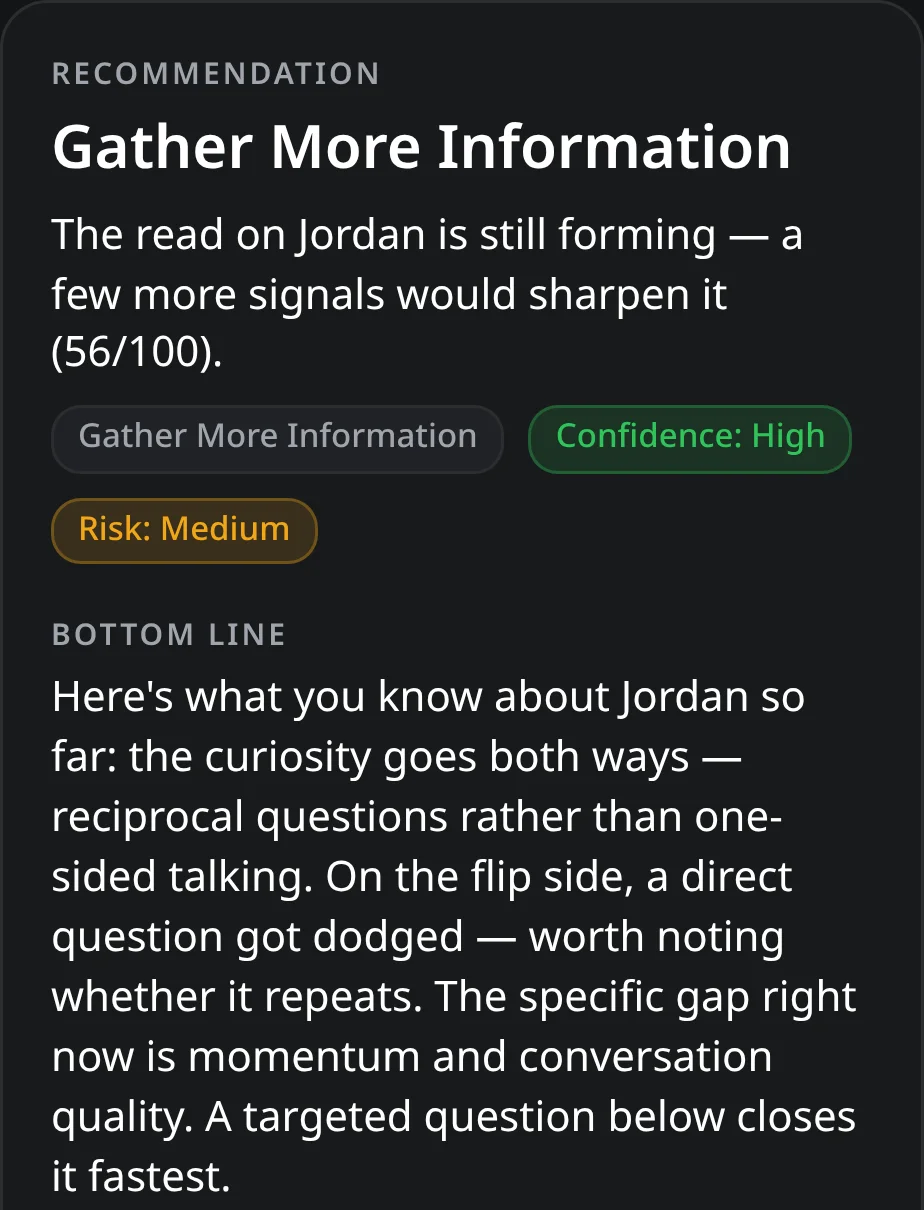
- Decision Score
- 56/100
- Recommendation
- Gather More Information
- Confidence
- High
- Risk
- Medium
What the evidence showed:
- Jordan remembered a previous conversation detail, indicating engagement with the exchange.
- However, Jordan did not propose a specific next step after Alex offered two possible days to meet.
What this means:
The available conversation contains encouraging evidence alongside an unresolved question. The recommendation is to gather more information rather than assume either genuine interest or dishonesty.
High confidence reflects confidence in the interpretation of the available evidence, not certainty about the person's identity or intentions.
The Decision Score evaluates how well the available evidence supports proceeding. It is not a rating of the person's character.
This illustrates an important distinction.
Perscivo doesn't produce a definitive declaration that someone is genuine or fraudulent. It analyzes the information provided and identifies what supports proceeding, what creates concern, and what remains unknown.
A Decision Brief can help you recognize a pattern that is difficult to see when you're personally involved in the conversation.
What should you do if someone keeps texting but won't meet?
Start with the broader communication history.
Look at whether invitations are acknowledged, explanations remain consistent, and both people contribute to progressing the interaction.
If appropriate, ask a direct question and observe whether the response actually addresses it.
You don't need to prove that someone is dishonest before deciding that continued involvement isn't worthwhile.
And if someone you've met online requests money, gift cards, cryptocurrency, financial information, or intimate material, don't wait for a conversation-analysis result to take precautions.
The FTC recommends never sending money or gifts to an online romantic interest you haven't met in person.
Why I created Perscivo
My experiences with online dating included questionable accounts, inconsistent information, and conversations that consumed considerable time without establishing whether continued involvement made sense.
Some accounts I communicated with subsequently disappeared or were removed by their platforms.
Those experiences helped shape Perscivo's evidence-based approach.
I wanted a way to examine questionable behavior without relying exclusively on instincts, assumptions, or advice from people who hadn't seen the actual conversation.
There's also a privacy consideration.
People don't always feel comfortable sharing their online dating experiences with friends or family. Sometimes they've invested considerable attention in someone and feel uncomfortable admitting how uncertain they are.
Perscivo provides another perspective in a private setting, using the information you choose to provide. It does not connect to your dating accounts or independently verify identities.
Its purpose is to help you see what's supported by evidence before deciding what to do next.
Frequently asked questions
How long is too long to wait before meeting someone from a dating app?
There is no universally appropriate number of days. Consider whether both people are making reasonable efforts to progress the interaction. If meeting keeps getting postponed, suggest a specific time and see whether they provide an alternative.
Is it a scam if someone refuses to video call?
Not necessarily. Repeated refusal to meet or video chat, combined with other concerning behavior, warrants caution. Avoid sending money or sensitive information, and remember that a video call itself cannot guarantee someone's identity.
Why does he text every day but never ask me out?
Possible explanations include hesitation, different intentions, practical circumstances, or a desire to maintain conversation without meeting. If you're interested in meeting, suggest a specific plan and evaluate the response rather than continuing to guess.
Why does she keep texting but won't agree to meet?
Examine whether she responds to invitations, proposes alternatives, and provides consistent information. Suggest one specific day and place; if that invitation also goes unanswered, look at the broader pattern before deciding whether continued communication is worthwhile.
Should I move our conversation to WhatsApp or Telegram?
You can choose where to communicate, but be cautious about immediate pressure to leave the original dating platform. Keep communication on the platform until you're comfortable, particularly when other details remain uncertain.
Can Perscivo tell me whether a dating profile is fake?
No. Perscivo examines the profiles, screenshots, and conversations you provide to identify observable evidence, inconsistencies, uncertainty, and relevant behavioral patterns. It does not authenticate someone's identity or guarantee that an account is genuine. If you suspect an account is fake, report it to the dating platform using its reporting tools.
Because instincts deserve evidence.